Your system supports DDR3 registered DIMMs (RDIMMs) or ECC unbuffered DIMMs (UDIMMs). Single and dual-rank DIMMs can be 1067- or 1333-MHz, and quad-rank DIMMs can be 1067-MHz.
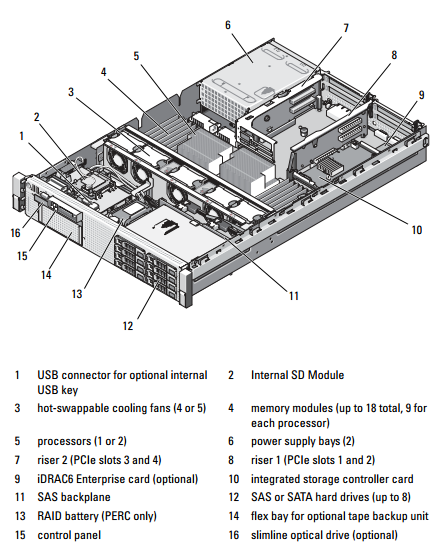
The system contains 18 memory sockets split into two sets of nine sockets, one set for each processor. Each nine-socket set is organized into three channels of three memory sockets per channel. The first socket of each channel is marked with white release levers.
The maximum memory that is supported on your system varies according to the types and sizes of memory modules being used:
• Single-rank and dual-rank RDIMMs of sizes 2-GB, 4-GB, and 8-GB (when available) are supported for a total of up to 144 GB.
• Quad-rank RDIMMs (two per channel) are supported for a total of up to 96 GB.
• 1-GB and 2-GB UDIMMs are supported for a total of up to 24 GB.
General Memory Module Installation Guidelines
To ensure optimal performance of your system, observe the following general
guidelines when configuring your system memory.
NOTE: Memory configurations that fail to observe these guidelines can cause your system to halt at startup without any video output of system messages.
• RDIMMs and UDIMMs cannot be mixed.
• No more than two UDIMMs can be populated per channel.
• Except for memory channels that are unused, all populated memory channels must have identical configurations.
• In a dual-processor configuration, the memory configuration for each processor must be identical.
• Memory modules of different sizes can be mixed within a memory channel (for example, 2-GB, 8-GB, and 4-GB), but all populated channels must have identical configurations.
• For Optimizer Mode, memory modules are installed in the numeric order of the sockets beginning with A1 or B1.
• For Memory Mirroring or Advanced ECC Mode, the three sockets furthest from the processor are unused and memory modules are installed beginning with socket A2 or B2 and proceeding in the numeric order of the remaining sockets (for example, A2, A3, A5, A6, A8, and A9).
• Advanced ECC Mode requires x4 or x8 DRAM device widths.
• The memory speed of each channel depends on the memory configuration:
– For single or dual-rank memory modules:
• One memory module per channel supports up to 1333 MHz.
• Two memory modules per channel supports up to 1067 MHz.
• Three memory modules per channel are limited to 800 MHz, regardless of memory module speed.
– For quad-rank memory modules:
• One memory module per channel supports up to 1067 MHz.
• Two memory modules per channel are limited to 800 MHz, regardless of memory module speed.
• If a quad-rank memory module is installed, then only one other memory module can be added to that channel.
• If quad-rank memory modules are mixed with single- or dual-rank modules, the quad-rank modules must be installed in the sockets with the white release levers.
• If memory modules with different speeds are installed, they will operate at the speed of the slowest installed memory module(s).
Mode-Specific Guidelines
Three memory channels are allocated to each processor. The number of channels and allowable configurations depend on the memory mode selected.
Advanced ECC (Lockstep) Mode Support
In this configuration, the two channels closest to the processor are combined to form one 128-bit channel. This mode supports SDDC for both x4- and x8-based memory modules. Memory modules must be identical in size, speed, and technology in corresponding slots.
Memory Mirroring Support
The system supports memory mirroring if identical memory modules are installed in the two channels closest to the processor (memory is not installed in the farthest channel). Mirroring must be enabled in the System Setup program. In a mirrored configuration, the total available system memory is one-half of the total installed physical memory.
Optimizer (Independent Channel) Mode
In this mode, all three channels are populated with identical memory modules. This mode permits a larger total memory capacity but does not support SDDC with x8-based memory modules. A minimal single-channel configuration of one 1-GB memory module per processor is also supported in this mode.
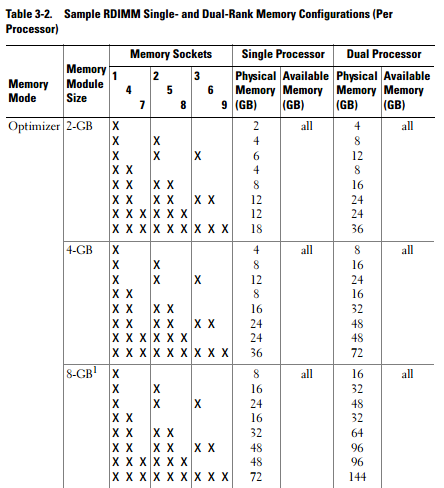
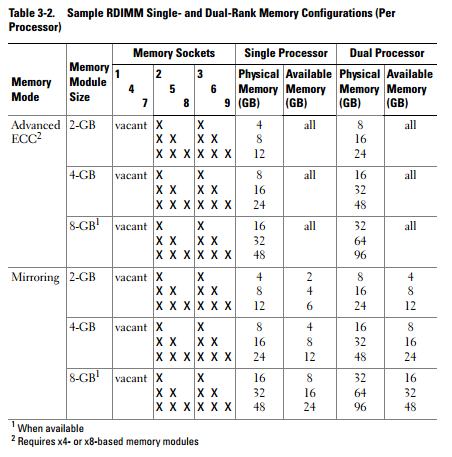
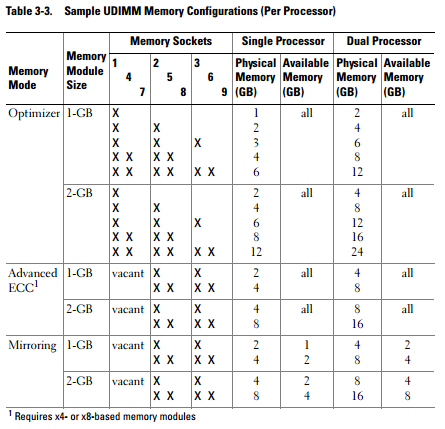
Table 3-2 and Table 3-3 show sample memory configurations that follow the appropriate memory guidelines stated in this section. The samples show identical memory-module configurations and their physical and available memory totals. The tables do not show mixed or quad-rank memory-module configurations, nor do they address the memory speed considerations of any configuration.
ผู้จำหน่าย RAM, SSD, HDD & Upgrade Parts สำหรับ Server อันดับ 1 ของประเทศไทย !!
RAM and SSD -> Server, Workstation, Apple Mac, Notebook, Desktop PC : Server Options -> Processor, Memory, SAS HDD, Storage Controller, Power Supply, Spare Part
MemoryToday Co., Ltd. 7 IT-Mall Fortune Town Bldg., 3rd Floor, Room 3R22, Ratchadapisek Rd., Dindaeng, Bangkok 10400 Tel: 02-641-0055 Fax: 02-641-0066 Web site engine's code is Copyright by PHP-Nuke. All Rights Reserved. PHP-Nuke is Free Software released under the GNU/GPL license.


 คำถามถามบ่อยของกระดานข่าว
 ค้นหา
ค้นหา รายชื่อสมาชิก
 ข้อมูลส่วนตัว
 เข้าระบบ